Ara students share practical AI projects with Ōtautahi tech community
26 November, 2026
AI capstones tackle real-world tech challenges
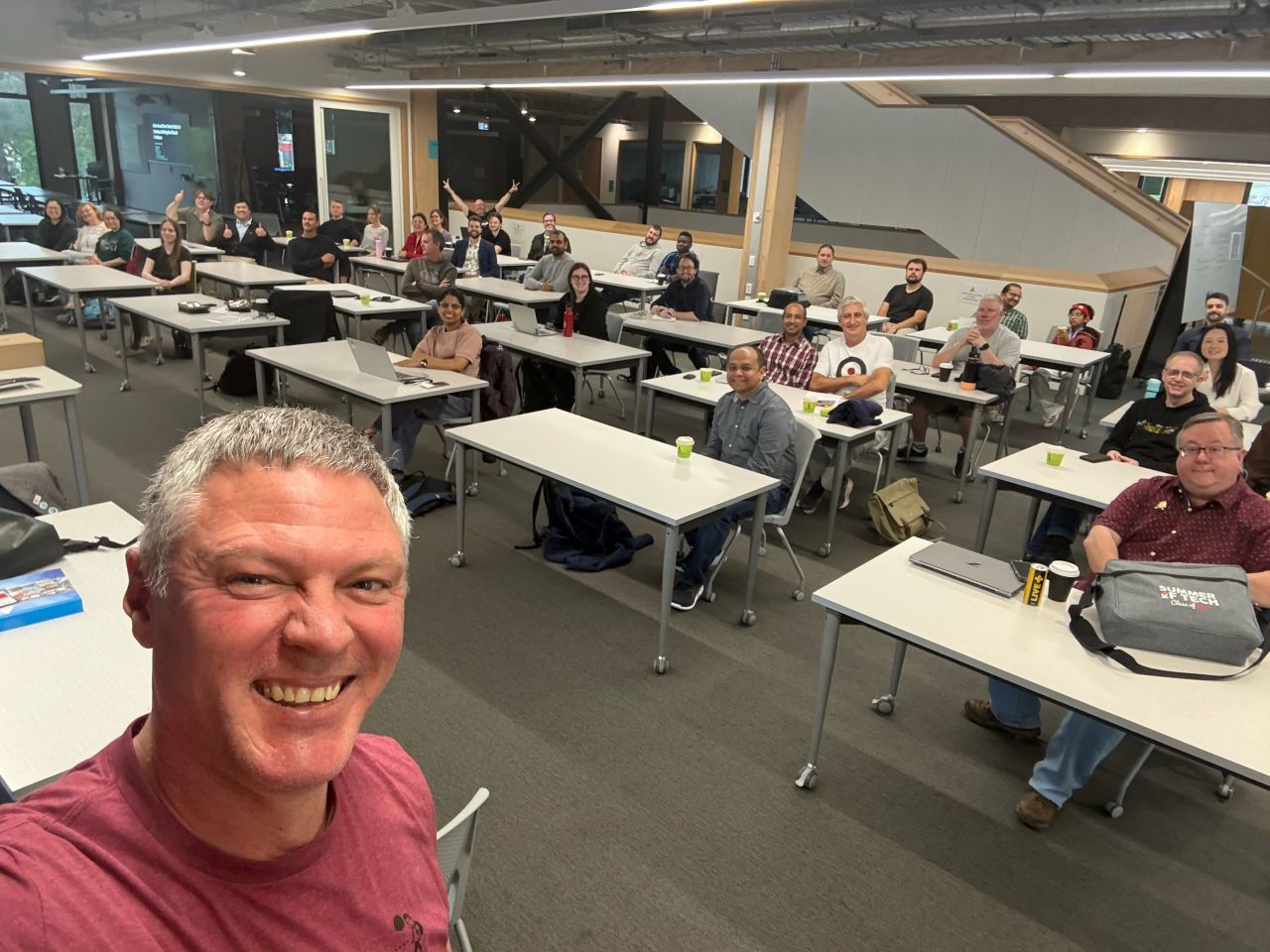
Steve Knutson, Code Camp organiser with attendees.
Generative AI can give you a beautifully polished answer. The problem is, it can also get it completely wrong.
That was one of the challenges four Ara computing students tackled through their final Bachelor of Information and Communications Technologies (ICT) capstone projects, developing AI tools for problems ranging from numeracy support and software cost estimation to complex dairy technology.
Last weekend, they took that work beyond Ara, presenting their projects to developers and technology professionals at Code Camp Christchurch 2026.
For Ara computing researcher and academic Dr Amit Sarkar, the common thread across all four projects is reliability engineering.
“If you ask a chatbot similar questions and it gives you three different answers, that’s not reliable,” he said.
Held at Ara’s City campus, Code Camp Christchurch was an independent community event organised by Steve Knutson, a Microsoft Regional Director and Microsoft Most Valuable Professional (MVP), technology consultant and co-founder of Christchurch-based Stratos Technology Partners.
The event brought ākonga (students) together with developers, consultants and other technology professionals for a day covering AI, Microsoft Copilot, data and analytics, software architecture and technology careers.
Knutson said the Ara projects demonstrated skills that are increasingly relevant well beyond traditional technology companies.
“AI is pervasive now and there is a high demand for developing agentic AI and a relatively low level of experience in the industry,” he said.
“The skills demonstrated in these capstone projects are applicable to a wide range of new opportunities.”
Dr Sarkar presented the four Ara projects under the theme ‘AI for Good’. Together, they showed how AI can be put to practical use.
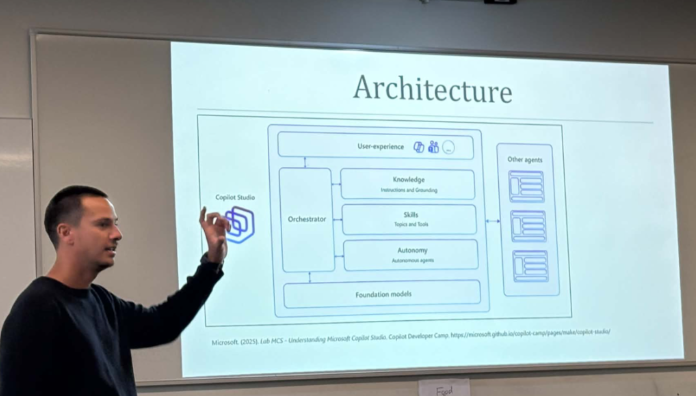
Daniel McLeod presenting his numeracy learning assistant.
Daniel McLeod developed a Socratic numeracy AI tool designed to support people who want to enter tertiary study but may not feel confident about their maths.
The important part is what it doesn’t do. It won’t complete homework or an assignment. Instead, it works through problems with a student, asking questions, explaining concepts and helping them prepare to tackle the work themselves.
“It will work with you, but never give you the answer,” Sarkar said.
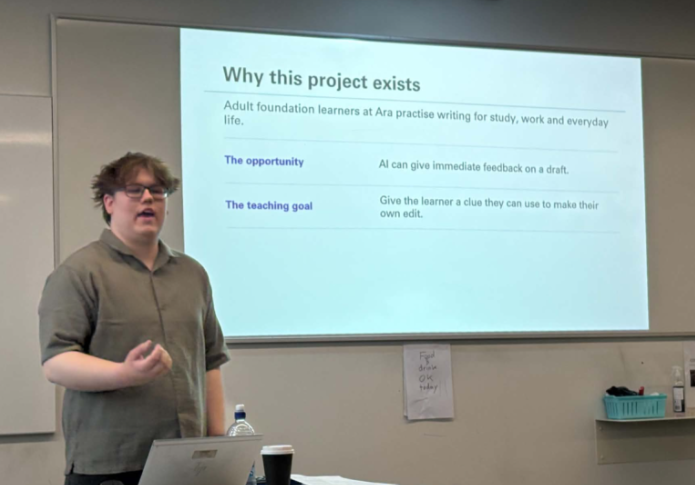
Keegan Olsen presenting at Code Camp Christchurch 2026.
Keegan Olsen’s project took the same approach to foundation-level literacy.
The projects built on earlier literacy and numeracy AI work at Ara and were supported by Ara Foundation funding. McLeod and Olsen worked on them as paid student interns to complete their capstones.
The work also has potential beyond the two student projects. Ara is looking at how the technology could support students more widely, with potential for it to eventually be used by other tertiary education providers.
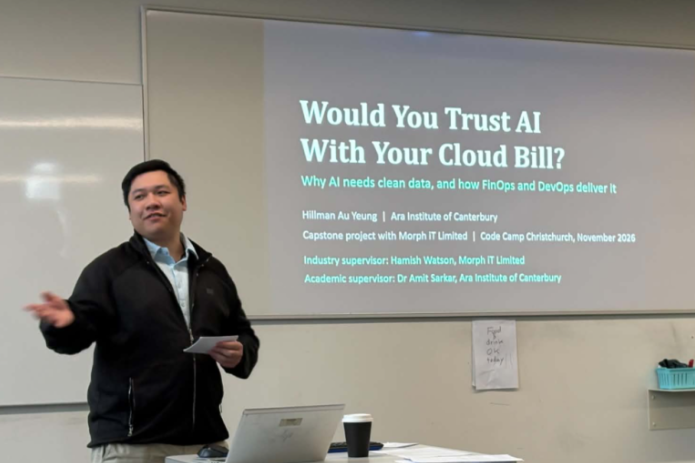
Hillman Auyeung presenting his FinOps AI agent.
Hillman Auyeung worked with Christchurch-based technology company Morph iT on a different challenge: helping businesses understand and manage what they spend on technology.
Auyeung developed a production-level FinOps AI agent that can identify opportunities to reduce software and technology costs.
For companies with large software bills, the potential savings can add up quickly. Hamish Watson, managing director at Morph iT estimated the approach could reduce costs by around 20 to 25 per cent in some situations. For a business spending $1 million a year, that could mean savings of up to $250,000.
The Morph iT team has worked with Ara over several semesters and recruited Ara graduates, giving Auyeung the opportunity to develop a product with a real business application and industry expectations behind it.
Lachlan McIlroy’s project put AI to work in another major New Zealand industry.
He developed an agentic AI tool, called AskMADCAP, designed to support people to ask questions about complex dairy technology software in natural, everyday language.
Christchurch-based MADCAP, now part of Jade Software, develops specialist software for dairy businesses, with clients including Fonterra and Nestlé, and systems used internationally.
Those systems help manage milk collection and work out efficient routes for tankers, as well as supporting processes to ensure a tanker is cleaned to the required standard before it heads out for the next collection.
For Knutson, projects like these point to an opportunity for organisations that might not traditionally think of themselves as technology companies.
“I would encourage companies looking to differentiate themselves to create an AI-first team as part of their strategy,” he said.
“This is where young people who aren’t tainted by old ways of working have an advantage.”
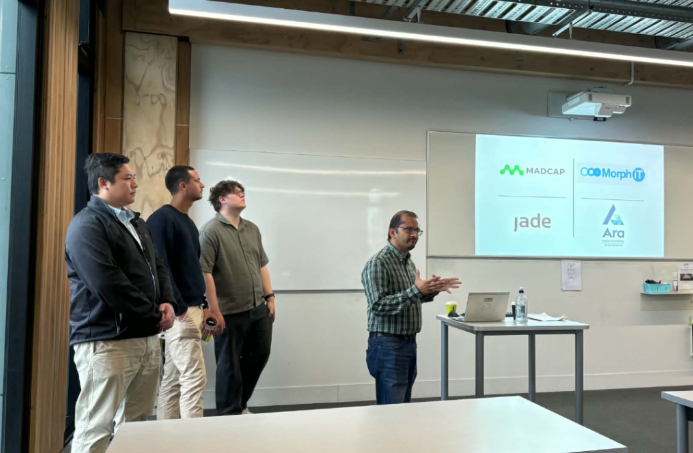
Dr Amit Sarkar, right, with the three Ara Bachelor of ICT students who presented in person at Code Camp 2026.
The four projects tackled different problems, but each required ākonga to develop a skill Dr Sarkar believes will become increasingly valuable: building AI systems that perform consistently, rather than simply getting them to work.
That meant thinking about hallucinations, quality assurance and what happened when people used a product in unexpected ways.
For the ākonga, much of the work was in the testing: asking whether an answer was accurate, whether the system would produce it consistently and whether they could trust the result.
“With production-level AI, 95 per cent is not good enough,” Sarkar said. “People are looking for almost 100 per cent. It should work every time.
“That’s very hard to achieve, and that’s where quality IT engineering comes into play.”
The projects showed that approach in practice. As part of Ara’s Bachelor of ICT, students develop AI responsibly and reliably, while also learning the engineering, testing, quality assurance and critical thinking needed to put it to work in the real world.
Each project represented around 300 hours of capstone work, with industry connection built into the experience.
Students had to plan and architect their solutions, understand and respond to real problems, test their work rigorously and explain why they made particular technical choices.
Code Camp gave them a different audience for those conversations. Instead of presenting to lecturers and an assessment panel, they discussed their work with people who build, implement and use technology for a living.
Knutson singled out the Ara showcase in his account of the event, noting the students’ end-to-end understanding of their projects and the practical learning evident in their work.
“I’m very impressed with these projects,” he said.
Sarkar said Christchurch’s strong technology community gives Ara students a particular advantage.
“Tech companies across Canterbury are developing products and services used around the world, and we have strong relationships across that community,” he said.
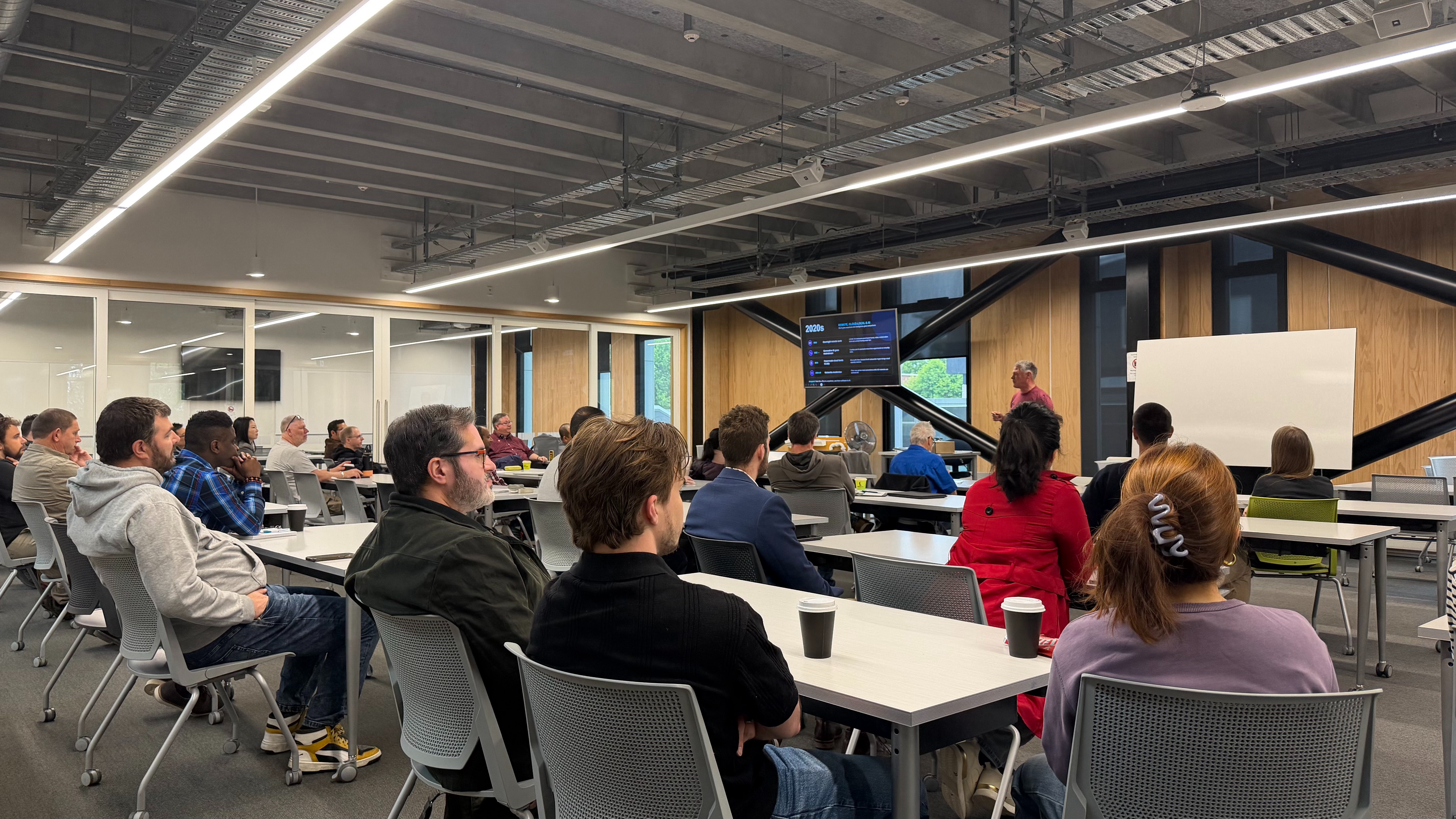
Steve Knutson presenting at Code Camp Christchurch 2026.
Ara’s City campus puts students in the centre of a substantial technology ecosystem. Christchurch’s tech sector contributes $2.4 billion to GDP and supports more than 15,000 jobs, with global technology businesses including Tait Communications and Seequent based in the city.
That gives Ara students opportunities to meet technology professionals, work with companies through capstone projects and internships, attend industry events and start building professional networks while they’re still studying.
“We’re so fortunate that everything is within half an hour’s drive,” Sarkar said. “There are some brilliant companies here and they’re very open to our graduates and discussions.”
For these four students, the connections were tangible. Morph iT, Jade Software and MADCAP were directly involved with their projects and emerging careers.
For Sarkar, Code Camp was a chance to celebrate that wider community as well as the students’ achievements.
“It’s about celebrating the entire tech ecosystem that we have here,” he said.
Those industry connections are already turning into employment opportunities. McIlroy has accepted a graduate position with MADCAP/Jade Software, McLeod has an offer from MADCAP/Jade Software, and Auyeung and Olsen are considering job offers.
Sarkar said employers were impressed with what Ara students could actually do. Their capstone projects gave them something substantial to put in front of an employer. They could explain the problem they started with, the decisions they made, how they built their solution and how they tested whether it could be relied on.
“These projects show who’s work-ready,” Sarkar said.
Knutson said AI was also making new kinds of work practical for organisations outside the traditional technology sector.
“I think there is an opportunity right now with many companies who aren’t in the traditional IT space,” he said.
For McLeod, Olsen, Auyeung and McIlroy, Code Camp was a chance to put hundreds of hours of work in front of the professional community they’re preparing to join.
They could show what they’d built, explain how they’d approached a real problem and answer questions from people already working in the sector. All four are finishing their study with employers interested in what they can do.
Ready to build what's next?
Study the Bachelor of Information and Communications Technologies at Ara and develop the practical skills needed for a fast-changing technology sector. Learn by doing, tackle complex problems and put your skills to work through projects with real-world relevance.
Find out more about Ara’s Bachelor of Information and Communications Technologies